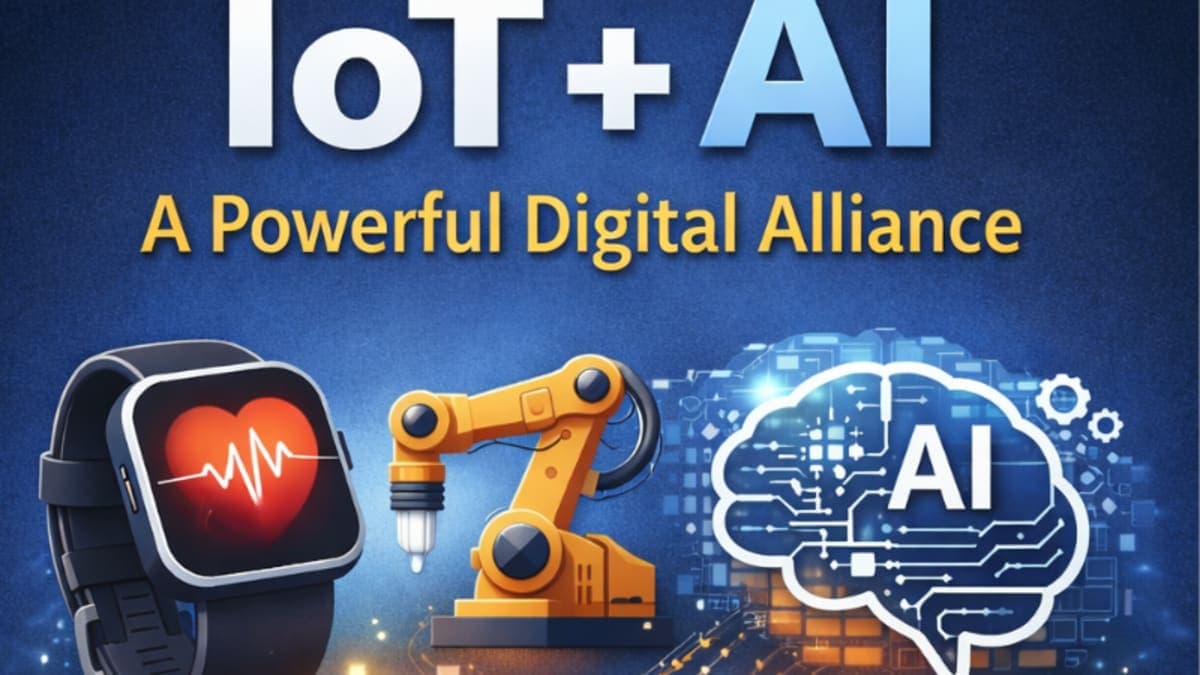
Internet of Things (IoT) and Artificial Intelligence: A Powerful Digital Alliance That Actually Solves Real Problems

Introduction: When Connected Devices Start Making Smart Decisions
Most people hear IoT and AI and imagine futuristic buzzwords. The reality is simpler and more useful.
If your smartwatch warns you about irregular heart activity, that’s not magic. If Google Maps reroutes traffic automatically, that’s not luck. These are Internet of Things (IoT) devices feeding data into Artificial Intelligence (AI) systems that analyze, predict, and decide.
Individually, IoT and AI are limited.
Together, they solve problems humans cannot scale manually.
This integration is widely referred to as AIoT (Artificial Intelligence of Things)—a term used in both academic research and industry whitepapers (e.g., IEEE, McKinsey, Gartner). The claim that AIoT is “transformative” is not marketing hype; it is supported by measurable improvements in efficiency, cost reduction, and safety across industries.
Key assumption (explicit):
This article assumes affordable sensors, reliable connectivity, and sufficient data quality. Without these, AIoT fails. That limitation is real and often ignored.
What Problem Does IoT Solve and Why It’s Incomplete Alone
The Internet of Things is fundamentally about visibility.
Sensors embedded in machines, homes, vehicles, and cities continuously collect data:
- Temperature
- Location
- Motion
- Energy usage
- Health metrics
This solves one problem: humans can’t watch everything, all the time.
But raw data does not equal insight.
Early IoT systems only reported:
- “Machine temperature is high”
- “Traffic is congested”
- “Energy usage increased”
A human still had to:
- Interpret the data
- Decide what it means
- Take action
At scale, this approach breaks down. That’s the structural weakness of IoT without AI.
What Artificial Intelligence Adds (Without the Sci-Fi Mythology)
Artificial intelligence, specifically machine learning, solves a different problem:
👉 pattern recognition at scale.
AI systems:
- Detect trends humans miss
- Predict outcomes before failure occurs
- Learn continuously from new data
This is not theoretical. Predictive models are already standard in:
- Network outage detection (relevant to your anal
ysis of large-scale failures like the Verizon outage)
- Fraud detection
- Recommendation engines
AI alone, however, is blind without data from the physical world.
How IoT and AI Actually Work Together (Step-by-Step)
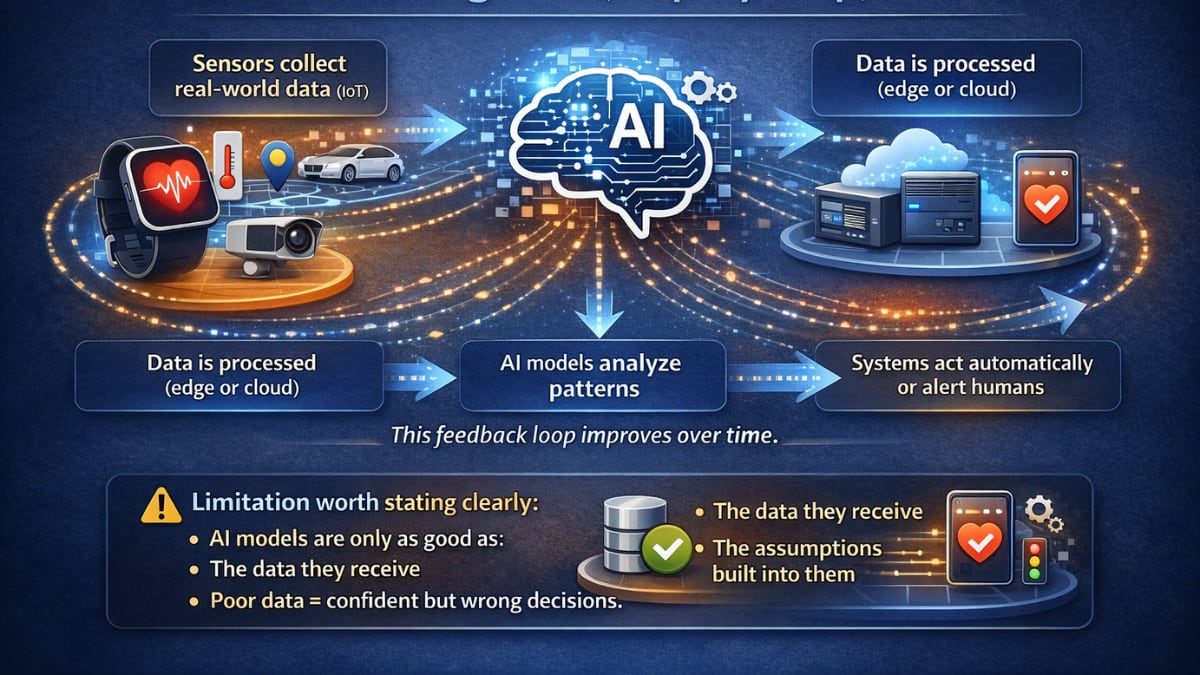
- Sensors collect real-world data (IoT)
- Data is processed (edge or cloud)
- AI models analyze patterns
- Decisions or predictions are generated
- Systems act automatically or alert humans
This feedback loop improves over time.
⚠️ Limitation worth stating clearly:
AI models are only as good as:
- The data they receive
- The assumptions built into them
Poor data = confident but wrong decisions.
Edge AI: Why Not Everything Goes to the Cloud
Sending all data to the cloud is:
- Slow
- Expensive
- Risky for privacy
Edge AI processes data near the source.
Examples where this is non-negotiable:
- Autonomous vehicles (milliseconds matter)
- Healthcare monitoring
- Industrial safety systems
Edge AI reduces latency and data exposure, but:
- Hardware costs are higher
- Models are usually smaller and less complex
This is a trade-off, not a silver bullet.
Real-World Impact
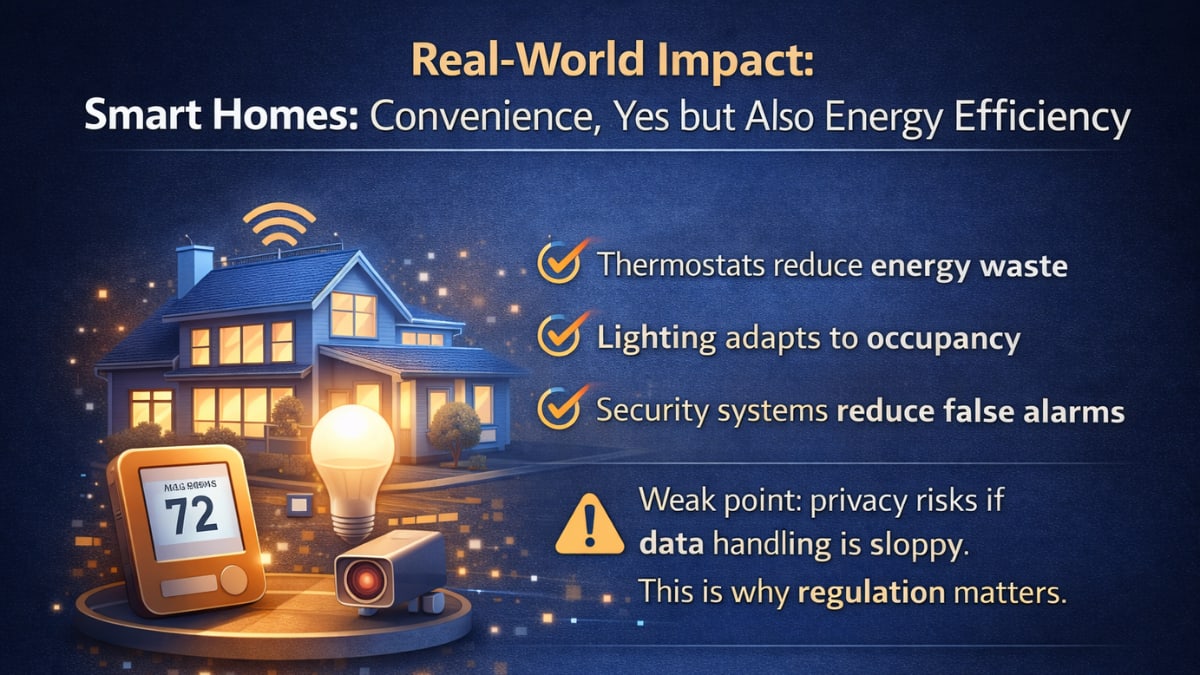
Smart Homes: Convenience, Yes but Also Energy Efficiency
AIoT smart homes learn behavior patterns, not just schedules:
- Thermostats reduce energy waste
- Lighting adapts to occupancy
- Security systems reduce false alarms
Weak point: privacy risks if data handling is sloppy. This is why regulation matters.
Industrial IoT (IIoT): Where AIoT Actually Pays for Itself
Predictive maintenance alone:
- Reduces downtime by up to 30–50% (industry averages reported by McKinsey)
- Prevents catastrophic failures
This is why factories adopt AIoT faster than consumers it has clear ROI.
Healthcare: From Reactive to Preventive Care
Wearables + AI:
- Detect anomalies early
- Reduce unnecessary hospital visits
- Enable remote patient monitoring
Critical limitation:
AI does not replace doctors. It augments decision-making. Over-reliance is dangerous.
Smart Cities: Efficiency Over Surveillance
Used correctly:
- Traffic congestion decreases
- Energy grids stabilize
- Waste collection becomes efficient
Used poorly:
- Mass surveillance
- Data misuse
Technology is neutral. Governance is not.
Agriculture: Precision Beats Guesswork
AIoT enables:
- Targeted irrigation
- Pest prediction
- Higher yield with fewer resources
This directly addresses food security not a minor problem.
Security & Privacy: The Weakest Link

IoT devices
expand attack surfaces
AI systems can amplify mistakes.
Real risks:
- Poorly secured sensors
- Data poisoning attacks
- Biased training data
Mitigation requires:
- Encryption
- Regular updates
- Ethical AI governance
Ignoring this undermines trust and adoption.
What the Future Looks Like (Based on Trends, Not Guesswork)

- 5G + Edge AI → real-time intelligence
- Autonomous systems → less human intervention
- Smaller, cheaper sensors → wider adoption
This mirrors how AI video generation evolved rapidly once compute and models matured similar to what you explained in your Google Veo 3.1 article, but applied to the physical world.
Why This Matters to You
If you are:
- A student → AIoT is a career multiplier
- A business owner → operational efficiency & cost control
- A tech enthusiast → this is where software meets reality
Understanding AIoT is no longer optional.
To understand AI-driven infrastructure failures, see:
👉 https://www.infonest.live/blog/verizon-outage-us-what-is-happening
For how AI models evolve rapidly with better inputs, compare with:
👉 https://www.infonest.live/blog/google-veo-3-1-vertical-videos-from-images
For consumer tech adoption patterns, relevant here:
👉 https://www.infonest.live/blog/oneplus-freedom-sale-discounts
Final Takeaway
IoT gives systems senses.
AI gives systems judgment.
Together, they don’t just automate they optimize decisions at scale. The promise is real, but only when data quality, security, and ethics are taken seriously.